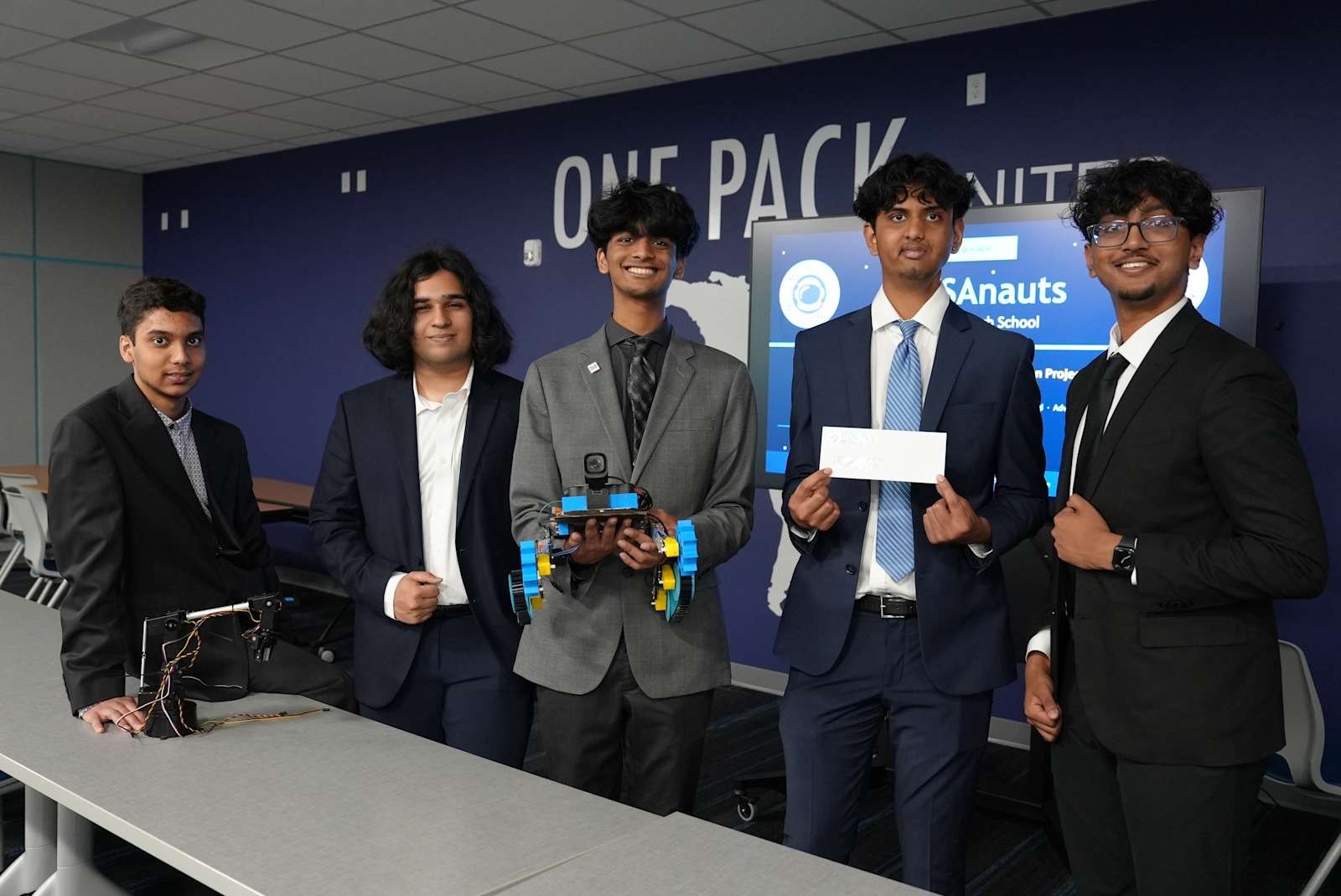
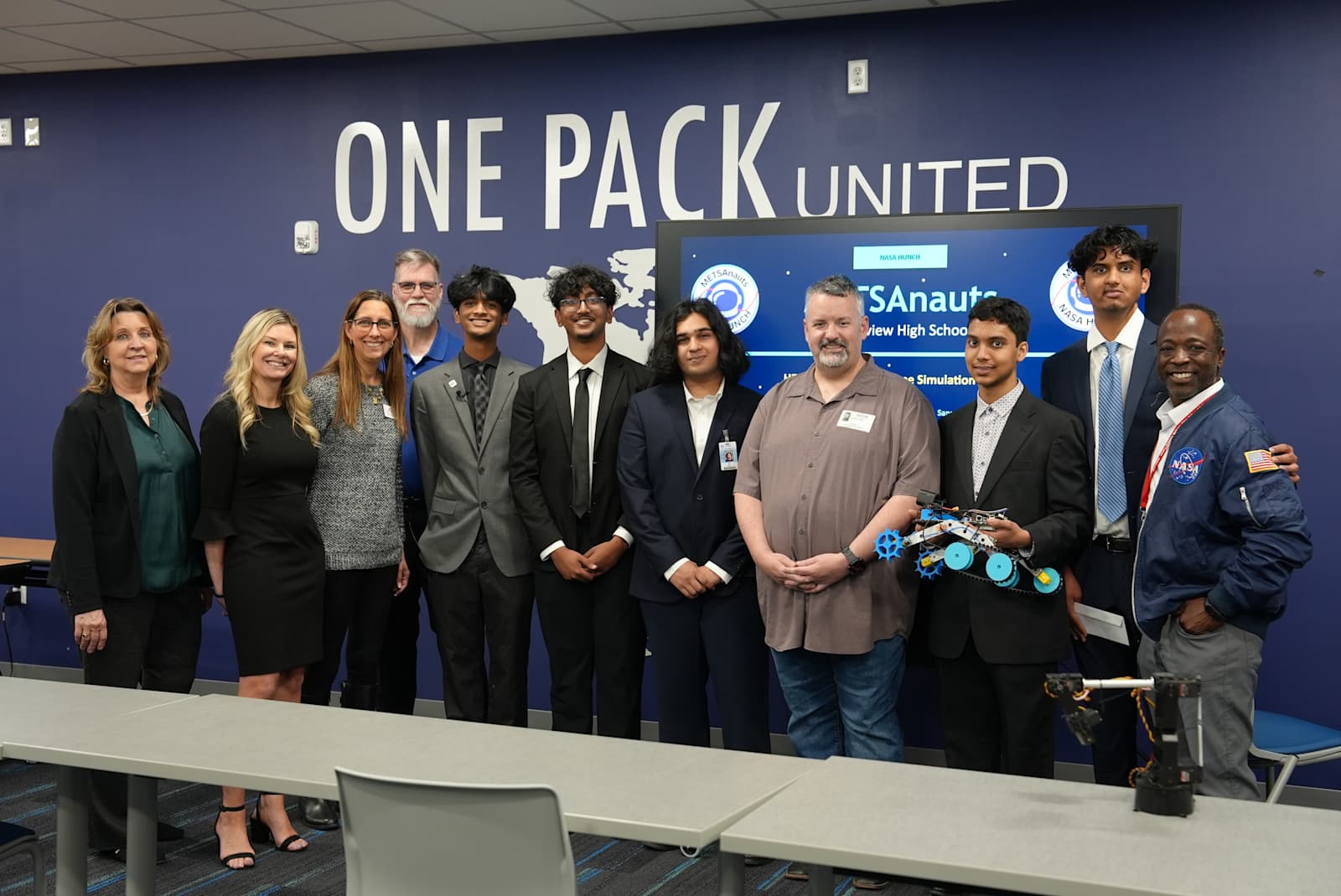
This year's mission: building a piece of Mars for NASA's HERA crews.
Inside NASA's Human Exploration Research Analog (HERA) at Johnson Space Center, crews called HERAnauts live in isolation for 45 days at a time to prepare for life in deep space. NASA wants those missions to feel as real as possible, with exploration activities that keep the crew immersed while still following mission protocols and communication delays. This year, that's our job: an 8 ft × 8 ft Martian landscape and a team of robots the crew can drive on it, remotely, from inside the habitat.
The mission: take a CubeSat from the HERA facility, drive it across Mars, and set it down at its destination, all without the crew ever leaving the habitat.
01 · A piece of Mars, 8 ft × 8 ft.
Our landscape will cover 8 ft × 8 ft, with side walls at least 3 ft tall, and fold into 4 ft × 4 ft sections so it can be packed away and stored at the HERA facility. The surface will model real Martian crater formations, including a crater-within-a-crater, with 3D-printed rocks, boulders, stones, and a regolith simulant to match the look and texture of the Martian ground. Pieces like hills, craters, and even mining or water-recovery sites can be moved around, so every mission can take place somewhere new.
02 · Never break the illusion.
If a robot's camera catches a ceiling, a wall, or the sky over Texas, the simulation is over. So we're designing visual barriers and a backdrop that keep the robots' cameras looking at Mars and nothing else, even when they climb out of a crater or bump over a rock. We're also building in lighting for both day and night operations.
03 · Four robots, four jobs.
The plan calls for four specialized robots. A transport robot carries a 10 cm CubeSat weighing 0.5 to 1 lb across the terrain. A manipulation robot uses an arm to lift the CubeSat and place it precisely, including handing it off between robots. Two support robots fill in around them with complementary capabilities. Every robot is controlled over Bluetooth from up to 100 meters away from the HERA module, and carries a camera, with standard and infrared options, that records to an SD card.
04 · Mission control for the crew.
HERAnauts won't be engineers with a remote in their hands. They'll drive the robots from a laptop or computer with multiple screens, one for each robot, using live video, monitoring tools, and data logging. Smart features could take it even further, like letting the robots scan the terrain on their own while the crew watches the results, or step in for a rescue if something goes wrong.
05 · Test it like a real mission.
Before any of this reaches HERA, we'll put it through mission scenarios of our own: day and night operations, communication system checks, emergency procedures, and real people trying out the controls to make sure they're easy to use.
It's a big list, and we can't wait to start checking it off. We'll be posting updates here all year as we build, test, and learn. Ad astra.
— METSAnauts