Research & Documentation
Technical Overview
METSAnauts · NASA HUNCH · FDR 2026
The METSAnauts project delivers a fleet of four small rovers and a companion terrain simulation for use inside NASA's HERA analog habitat at Johnson Space Center. The system is designed for non-technical astronaut crew: a web-based control interface (including an AI-powered natural language mode) that lets crew operate rovers without robotics experience.
HERA (Human Exploration Research Analog) simulates long-duration deep-space missions. Our rovers give crew a hands-on tool for surface exploration tasks and terrain assessment during those simulations.
MOBILITY
Rover platform
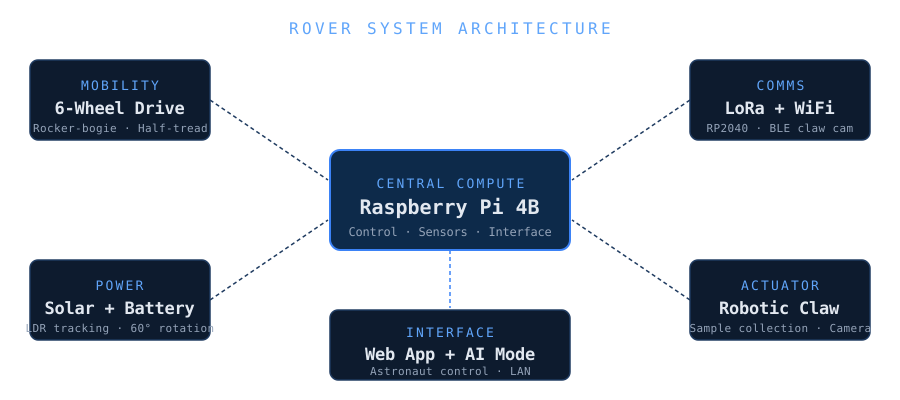
- Six-wheel drive with rocker-bogie suspension for passive obstacle navigation
- Half-tread wheels for grip on loose and uneven terrain
- Raspberry Pi 4B as the onboard compute unit
- Modular design — components are easy to replace or swap in the field
- Robotic sample-collection claw for object manipulation tasks
COMMUNICATIONS
Multi-mode communication
- Primary long-range link via LoRa (SX1276), chosen for range and reliability in enclosed environments
- WiFi and Bluetooth as secondary channels for close-range and real-time control
- RP2040 coprocessor handles the LoRa radio stack separately from the main Pi
- USB hot-swap allows the comms module to be replaced without disassembly
POWER
Solar power & tracking
- Onboard solar panels provide supplemental and emergency power
- Dual light-dependent resistors (LDRs) compare illumination across faces
- Rover body can rotate to maximize panel exposure at low sun angles
- Design is reversible — functions correctly whether rover is upright or flipped
- Researched electrostatic dust-removal methods inspired by MIT lunar regolith work
CONTROL INTERFACE
Astronaut control app
- Web application built for non-technical crew aboard HERA
- Standard command mode: discrete controls for movement, claw, and camera
- AI-powered mode: crew types plain-language instructions, system generates rover commands
- Secondary camera on the claw provides tool-perspective view during sample collection
- Designed to work reliably under the communication constraints of the HERA habitat
TERRAIN
BothScape simulation
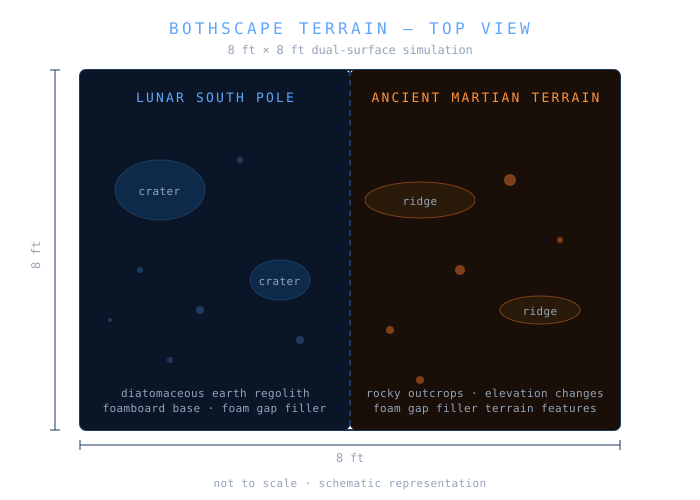
- 8′ × 8′ dual-surface terrain representing lunar south pole and ancient Martian terrain
- Constructed from foamboard base, foam gap filler for surface features, diatomaceous earth as lunar regolith
- Split-surface design lets crew run side-by-side planetary comparison scenarios
- Sized to fit within the HERA habitat footprint